
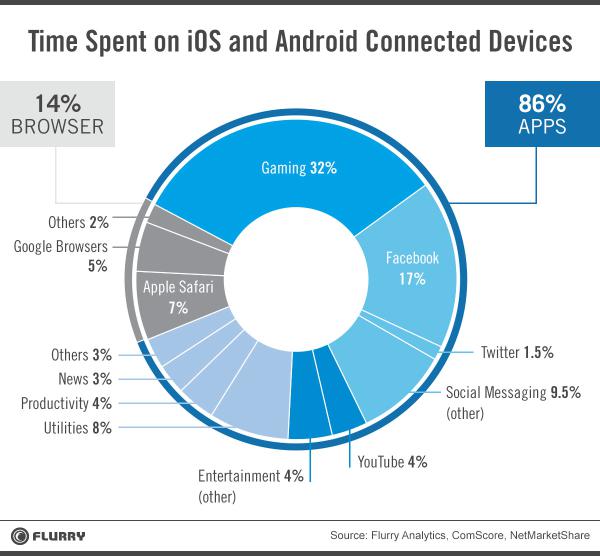
After popularity of HTML5 most of us predicted that HTML5 websites & Hybrid Apps offering same functionality like Native Apps will be used more on smartphones.
But recent study of Flurry shows that their is a significant drop of 6% in Mobile website usages in the U.S.A. Last year March 2013, on an average 20% (31 minutes) of smartphone users time was spent on Mobile Website, has now dropped to 14% (20 minutes).
People are also spending longer time on their phones (average to 2h 42m per day compared to 2h 38m in March 2013).
So there is a clear increase of Mobile Apps usage seen as compared to Mobile Websites. Mobile Apps usage increased to 86% compared to 80% last year March 2013. Gaming apps maintained their leadership position at 32% of time spent. Social and messaging applications, including Facebook, increased share from 24% to 28%. Entertainment (including YouTube) and Utility applications maintained their positions at 8% each, while productivity apps saw their share double from 2% to 4% of the overall time spent.
Flurry concludes by saying – “But one thing is clear – apps have won and the mobile browser is taking a back seat. Now every company in the world including Google is adjusting to that reality.”
This data will really help every business to decide their mobility strategy.
Resource Center
These aren’t just blogs – they’re bite-sized strategies for navigating a fast-moving business world. So pour yourself a cup, settle in, and discover insights that could shape your next big move.
What Is Agentic AI and How Is It Different from Generative AI?
Artificial intelligence has evolved rapidly over the past few years, moving from simple automation to highly intelligent systems capable of reasoning, generating content, and performing complex tasks. Among the [...]
Can Generative AI Replace Human Workflows?
The rapid evolution of Generative AI has triggered one of the most critical business questions of the decade: Can generative AI replace human workflows? From automated content creation and [...]
How Do You Choose the Right AI Development Company?
Artificial Intelligence is no longer a futuristic ambition—it is a competitive necessity. From predictive analytics and automation to generative AI and intelligent decision-making systems, organizations across industries are investing [...]
