
The way software is built is undergoing a fundamental transformation. Tasks that once demanded weeks of manual engineering effort are now executed in hours through intelligent automation, autonomous agents, and AI-driven workflows. With this shift accelerating across the developer ecosystem, OpenAI has introduced a major evolution of its coding assistant with the launch of the Codex macOS app.
This new standalone application represents a significant step in agentic software development—where multiple AI agents operate independently, collaborate in parallel, and assist developers across complex, long-running tasks. From our experience working with modern development teams, this release reflects a broader industry movement toward AI-first engineering environments that prioritize speed, orchestration, and scale.
Why the Codex App Launch Matters for Developers and Enterprises
Over the past year, AI coding tools have shifted from simple code suggestion engines to fully autonomous development collaborators. Agentic development platforms—where AI agents write, refactor, test, and iterate code independently—have rapidly gained traction among startups and large engineering organizations alike.
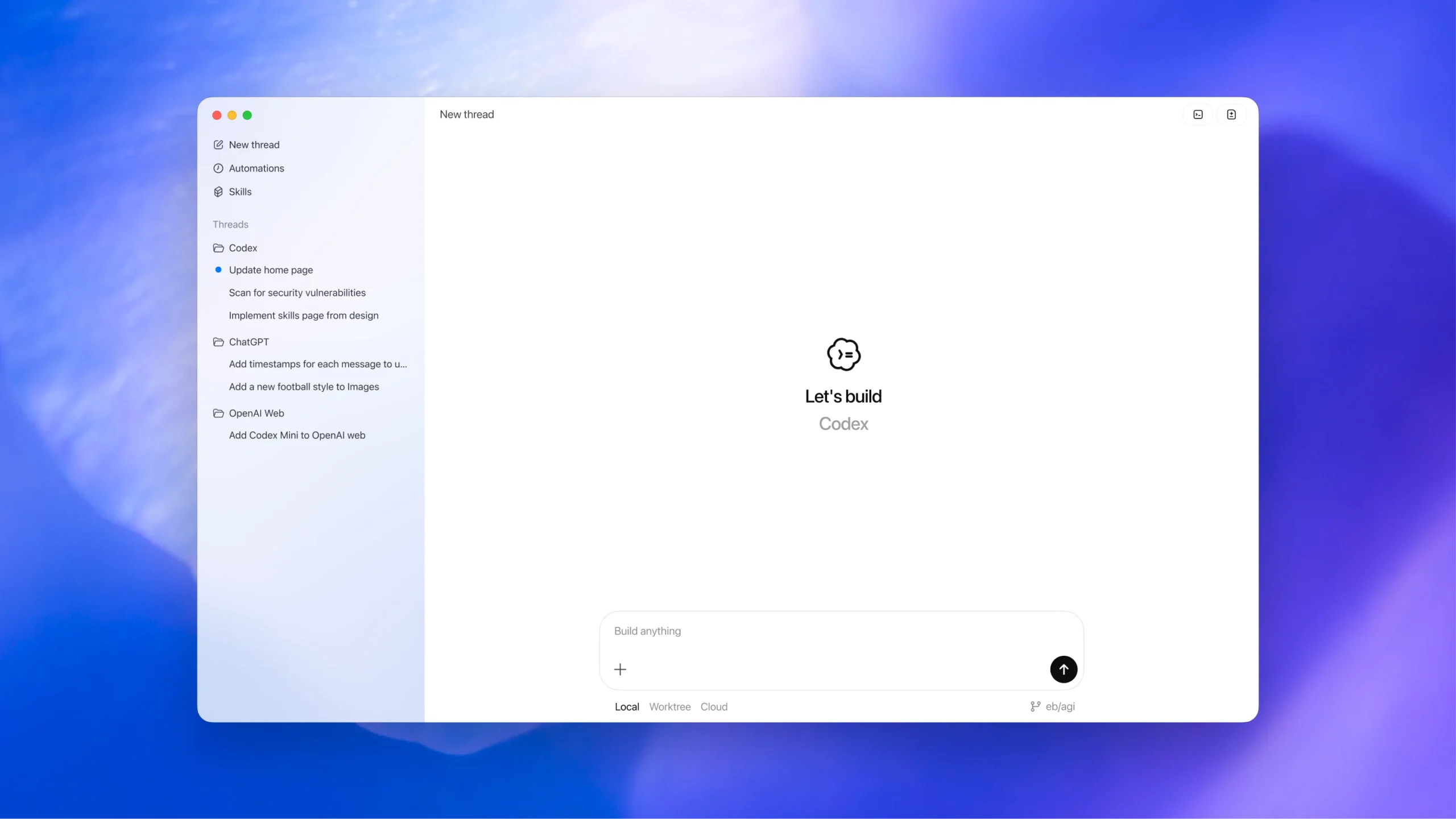
Until now, Codex existed primarily as a command-line tool and web interface. While powerful, those interfaces required developers to adapt their workflows to the tool. The new Codex app reverses that dynamic by providing a dedicated “command center” that centralizes agent orchestration, task management, and AI collaboration in a single macOS-native experience.
From a practical standpoint, this dramatically lowers friction for developers experimenting with advanced AI-assisted software engineering.
A Purpose-Built macOS App for Agentic Development
The Codex app is designed specifically for Apple computers and introduces a clean, minimal interface optimized for professional development workflows. Rather than functioning as a passive assistant, the app enables developers to manage multiple AI agents simultaneously, each running in its own execution thread and organized by project.
Key structural features include:
-
Parallel agent execution for faster delivery
-
Project-based threads to track changes and decisions
-
Reviewable agent outputs to maintain human oversight
-
Persistent task queues for long-running automations
This approach aligns with how modern engineering teams already think about work: distributed, asynchronous, and outcome-driven.
Multi-Agent Collaboration as a First-Class Feature
One of the most notable advancements in the Codex app is its native support for parallel AI agents. Each agent can independently work on discrete tasks—such as implementing features, debugging issues, or generating documentation—while remaining part of a unified project context.
From our experience, this model mirrors real-world engineering teams, where multiple contributors operate concurrently but coordinate through shared context and review cycles. By enabling agents to function in parallel threads, OpenAI is effectively modeling a scalable AI development team within a single interface.
This capability is particularly impactful for:
-
Complex codebases
-
Large refactoring initiatives
-
Rapid prototyping
-
Continuous integration workflows
Automation and Background Execution
Another major enhancement introduced with the Codex app is background automation. Developers can configure agents to run tasks on a predefined schedule or continuously in the background, with results placed in a review queue upon completion.
This feature supports use cases such as:
-
Nightly code reviews
-
Automated refactoring tasks
-
Dependency updates
-
Test generation and validation
-
Long-running research or analysis tasks
By decoupling execution time from active developer input, the Codex app enables a more asynchronous and efficient development cycle—an approach increasingly favored by high-performing engineering teams.
Agent Personalities and Human-AI Collaboration
Recognizing that developers work differently, OpenAI has introduced selectable agent personalities within the Codex app. These range from pragmatic and direct to more empathetic interaction styles, allowing teams to tailor AI collaboration to their preferred working dynamics.
While subtle, this feature reflects a deeper understanding of human-AI collaboration: productivity improves when tools adapt to people—not the other way around. In enterprise environments, this flexibility can also support onboarding, cross-functional collaboration, and diverse team preferences.
Powered by GPT-5.2-Codex
At the core of the new app is GPT‑5.2‑Codex, OpenAI’s most advanced coding model to date. According to OpenAI, this model is optimized for sophisticated, real-world programming tasks and complex code reasoning.
OpenAI CEO Sam Altman has emphasized that while GPT-5.2-Codex has always been powerful, its usability was limited by interface constraints. The Codex app addresses this gap by pairing advanced model capability with a flexible, developer-centric interface.
This combination is designed to make high-end AI coding accessible without sacrificing control or transparency.
Benchmarks, Reality, and Developer Experience
From a benchmarking perspective, GPT-5.2-Codex currently leads on TerminalBench, which measures command-line programming performance. However, results from SWE-bench and other real-world evaluations show that competing models from Google and Anthropic perform within a comparable range.
In practice, agentic development effectiveness is not determined by benchmarks alone. Developer experience, workflow integration, and task orchestration play an equally critical role. From what we observe across engineering teams, productivity gains often stem from how well AI tools fit into daily workflows, not just raw model performance.
The Codex app appears intentionally designed to compete on this dimension.
Skills Library Beyond Code Generation
The Codex app also introduces a built-in skills library, extending agent capabilities beyond code generation. Skills such as image generation and auxiliary task support enable agents to assist with a broader range of development-adjacent activities.
This expansion signals a move toward full-stack AI agents that can contribute across design, documentation, and implementation—reducing handoffs and accelerating delivery timelines.
Availability and Access Strategy
Access to Codex is included with ChatGPT subscriptions, meaning Plus, Pro, Business, Enterprise, and Edu users can use the app and purchase additional credits as needed. With this launch, OpenAI has also temporarily extended access to free users and its low-cost Go tier.
This aggressive access strategy suggests a clear objective: accelerating adoption and reclaiming mindshare in a competitive AI coding tools market that includes players like Anthropic and Cursor.
From a market perspective, lowering entry barriers often catalyzes experimentation—particularly among independent developers and small teams that later scale usage into enterprise environments.
What This Means for Modern Software Teams
From our experience advising organizations on AI-enabled development, tools like the Codex app mark a transition from AI-assisted coding to AI-orchestrated software development.
The implications are significant:
-
Faster time-to-market
-
Reduced cognitive load for engineers
-
Greater focus on architecture and problem-solving
-
New expectations around developer productivity
As AI agents become embedded into daily workflows, the role of developers evolves—from writing every line of code to supervising, directing, and refining intelligent systems.
Frequently Asked Questions (FAQs)
1. What is the OpenAI Codex app?
The Codex app is a standalone macOS application from OpenAI that allows developers to manage multiple AI coding agents, automate tasks, and collaborate with AI in parallel workflows.
2. Who can use the Codex app?
The app is available to ChatGPT subscribers, including Plus, Pro, Business, Enterprise, and Edu users, with temporary access extended to free and Go tier users on Apple computers.
3. How is the Codex app different from previous Codex tools?
Unlike the command-line and web versions, the Codex app provides a centralized interface for managing multiple agents, background automations, and project-based workflows.
4. What model powers the Codex app?
The app is powered by GPT-5.2-Codex, OpenAI’s most advanced coding-focused AI model.
5. Is the Codex app suitable for enterprise development teams?
Yes. The app is designed to support complex, long-running tasks, parallel workflows, and collaborative development, making it suitable for enterprise and large-scale engineering teams.
Resource Center
These aren’t just blogs – they’re bite-sized strategies for navigating a fast-moving business world. So pour yourself a cup, settle in, and discover insights that could shape your next big move.
What Are the Latest Trends in Digital Transformation for 2026?
Digital transformation is no longer a strategic option—it has become a foundational necessity for organizations aiming to remain competitive in a rapidly evolving digital economy. As we move into [...]
What Technologies Are Used in Digital Transformation Services?
Digital transformation is no longer a future ambition—it is a present-day business necessity. Organizations across industries are rapidly evolving their operations, customer experiences, and business models by integrating advanced [...]
What Role Does Data Analytics Play in Digital Transformation?
In today’s rapidly evolving digital landscape, organizations are no longer relying on intuition or traditional methods to drive business decisions. Instead, data analytics in digital transformation has emerged as [...]
