
In today’s rapidly evolving digital landscape, generative AI platforms have transformed how businesses build solutions, automate workflows, and deliver intelligent user experiences. While these systems appear seamless on the surface, two foundational techniques—prompt engineering and few-shot learning—play a critical role in shaping the accuracy, reliability, and overall performance of AI-driven applications.
From our experience working with enterprises and building AI-enabled tools, we consistently observe that teams who understand these techniques unlock exponentially better outcomes from large language models (LLMs). This blog explores both concepts in depth—why they matter, how they influence generative AI, and the strategic value they offer to businesses embracing AI-first operations.

Understanding Prompt Engineering: The Blueprint for High-Quality AI Output
Prompt engineering has become one of the most essential skills in the AI ecosystem. It involves designing, structuring, and optimizing input prompts to guide generative AI platforms toward precise, predictable, and context-aware outputs.
In practical terms, a well-engineered prompt gives direction to the model—much like a well-written requirement document guides a software engineer. Without clarity and structure, the output becomes inconsistent, generic, or misaligned with business objectives.
Prompt engineering is now considered a primary keyword in modern AI development because it directly influences model accuracy, workflow automation, and business-level AI adoption. The quality of the prompt often becomes the primary factor that determines whether a model performs at 40% accuracy or 95%.
Why Prompt Engineering Matters So Much
Our experience shows that even the most advanced generative AI models behave differently based on the way instructions are framed. We have seen enterprises struggle with inconsistent AI responses—only to discover that the issue wasn’t the model, but the prompt.
Prompt engineering helps businesses:
-
Reduce errors and hallucinations
-
Achieve consistent output formats
-
Improve contextual understanding
-
Automate complex tasks with minimal human review
-
Maximize the ROI of AI integrations
When an instruction is crafted strategically, it provides structure, intent, constraints, and clarity—allowing generative AI systems to interpret tasks more effectively.
Key Techniques We Apply in Prompt Engineering
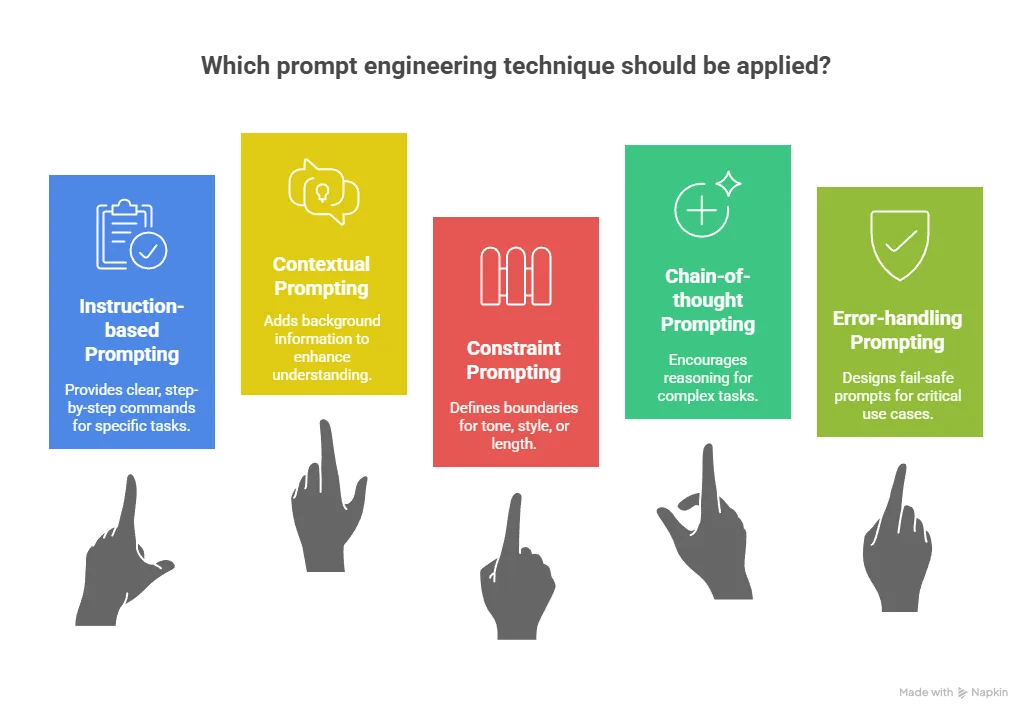
Over time, our teams have refined several prompt engineering strategies across different projects:
-
Instruction-based prompting: Giving explicit, step-by-step commands
-
Contextual prompting: Adding background information and domain context
-
Constraint prompting: Defining boundaries such as tone, style, or length
-
Chain-of-thought prompting: Encouraging reasoning for complex tasks
-
Error-handling prompting: Designing fail-safe prompts for critical use cases
These approaches ensure that generative AI systems deliver results aligned with brand voice, regulatory needs, and use-case accuracy.

Few-Shot Learning: Teaching AI with Minimal Examples
Few-shot learning is another powerful concept critical to generative AI success. It allows AI models to learn a specific pattern or behavior using only a few examples provided within the prompt. This is especially valuable for business use cases where large datasets are not readily available.
Few-shot learning is a secondary keyword in the AI industry, yet it has rapidly become a cornerstone of enterprise AI development due to its efficiency and scalability.
How Few-Shot Learning Works
In simple terms, you show the model a handful of examples—often 2 to 10—to teach it how to perform a specific task. These examples help the model recognize:
-
Structure
-
Tone
-
Format
-
Logic
-
Intent
This eliminates the need for building a custom dataset or training a model from scratch.
For example, if a business wants AI to generate product descriptions in a specific tone, offering a few structured samples can help the model replicate the pattern consistently.
The Business Value of Few-Shot Learning
Enterprises increasingly rely on few-shot learning because it:
-
Reduces the need for large-scale training data
-
Speeds up deployment of AI capabilities
-
Delivers domain-specific results quickly
-
Allows for rapid experimentation and iteration
-
Minimizes engineering overhead
From streamlining document summaries to generating domain-specific reports, few-shot learning acts as a practical bridge between raw AI capabilities and business-ready output.
The Synergy Between Prompt Engineering & Few-Shot Learning
One of the most impactful insights we’ve gained from implementing AI across industries is that prompt engineering and few-shot learning work best together. They aren’t separate techniques; they are complementary strategies that improve AI output quality, reduce manual intervention, and streamline fine-tuning processes.
How They Complement Each Other
-
Prompt engineering provides structure, while few-shot learning provides examples.
-
Prompt engineering defines rules, while few-shot learning provides patterns.
-
Prompt engineering ensures clarity, while few-shot learning ensures accuracy.
This combination transforms generative AI from a basic text model into a highly specialized, context-aware engine capable of supporting enterprise-grade applications.
Through this synergy, businesses can achieve:
-
High-accuracy responses
-
Custom-style content generation
-
Efficient workflow automation
-
Reduced reliance on manual prompt adjustments
-
Consistency across large-scale operations
AI behaves significantly better when it not only receives clear instructions but also understands examples of the desired outcome.

Why These Techniques Are Essential for Enterprise AI Adoption
As organizations increasingly adopt large language models for automation, customer service, knowledge mining, and content generation, understanding these techniques becomes critical. Based on our real-world implementations, there are four major reasons why prompt engineering and few-shot learning are essential.
1. They Reduce Model Hallucinations
A well-structured prompt with supporting examples significantly lowers the chances of false or fabricated information—a major challenge in generative AI systems.
2. They Enable Rapid Customization
Instead of fine-tuning models for every small use case, businesses can quickly customize output at the prompt level using few-shot examples.
3. They Improve User Trust
Consistent, accurate responses build trust among users and stakeholders—especially in regulated sectors like healthcare, finance, and compliance.
4. They Lower Total Development Costs
Prompt engineer-driven solutions eliminate the need for heavy model retraining, saving both time and cost while still achieving high performance.
Real-World Use Cases Where These Skills Make a Difference
We’ve implemented advanced prompt engineering and few-shot learning solutions across multiple industries. Below are some real-world examples showcasing how powerful these techniques can be:
AI-Powered Document Automation
Using structured prompts and 3–5 examples, we’ve enabled clients to automate:
-
Compliance summaries
-
Contract clause extraction
-
Audit-ready reports
This reduces manual review time significantly.
Intelligent Customer Support Assistants
Through prompt templates and task examples, AI systems can now:
-
Understand user queries
-
Generate accurate responses
-
Maintain brand tone
Enterprise Knowledge Systems
Few-shot examples help generative AI:
-
Answer domain-specific questions
-
Retrieve context-aware insights
-
Generate structured outputs like diagnostics or SOPs
Marketing & Content Automation
Customized prompts enable AI to match brand guidelines, tone, and style—creating marketing content that aligns with the company’s identity.
The Future: AI Development Will Depend on These Techniques
The evolution of generative AI models is accelerating, but the role of prompt engineering and few-shot learning will continue to grow. As models become more powerful, the need for clear, structured, example-driven guidance becomes even more important.
Tomorrow’s AI-driven enterprises will rely heavily on:
-
Prompt libraries
-
Reusable prompt templates
-
System prompts for governance
-
Standardized few-shot training blocks
The organizations that master these techniques will deliver better automation, better customer experiences, and better data-driven decision-making.
FAQs on Prompt Engineering & Few-Shot Learning
1. Why is prompt engineering so important in generative AI platforms?
Because the quality of the prompt directly influences how accurately the AI interprets and responds. Strong prompt engineering leads to more reliable, context-aware, and consistent outputs.
2. Does few-shot learning reduce the need for model training?
Yes. Few-shot learning allows businesses to achieve fine-tuned behavior without large datasets or complex retraining, making AI adoption faster and more scalable.
3. How do prompt engineering and few-shot learning work together?
Prompt engineering provides structured instructions, while few-shot learning supplies examples. Together, they shape the model’s reasoning, accuracy, and behavior.
4. Are these techniques essential only for developers?
No. Product teams, marketers, analysts, support teams, and business leaders all benefit from understanding these techniques to leverage AI effectively.
5. Can prompt engineering improve enterprise automation?
Absolutely. Prompt engineering enables precise, consistent, automation-ready AI outputs that integrate seamlessly into business workflows.
Resource Center
These aren’t just blogs – they’re bite-sized strategies for navigating a fast-moving business world. So pour yourself a cup, settle in, and discover insights that could shape your next big move.
What Are the Latest Trends in Digital Transformation for 2026?
Digital transformation is no longer a strategic option—it has become a foundational necessity for organizations aiming to remain competitive in a rapidly evolving digital economy. As we move into [...]
What Technologies Are Used in Digital Transformation Services?
Digital transformation is no longer a future ambition—it is a present-day business necessity. Organizations across industries are rapidly evolving their operations, customer experiences, and business models by integrating advanced [...]
What Role Does Data Analytics Play in Digital Transformation?
In today’s rapidly evolving digital landscape, organizations are no longer relying on intuition or traditional methods to drive business decisions. Instead, data analytics in digital transformation has emerged as [...]
