
Artificial intelligence has evolved rapidly over the past few years, moving from simple automation to highly intelligent systems capable of reasoning, generating content, and performing complex tasks. Among the most transformative developments in this landscape are Generative AI and Agentic AI. While generative models have already reshaped industries such as marketing, software development, and customer service, the emergence of Agentic AI systems signals a deeper shift toward autonomous decision-making and task execution.
As organizations continue investing in AI-powered automation, understanding the difference between Agentic AI vs Generative AI becomes essential. Both technologies belong to the broader artificial intelligence ecosystem, yet they serve fundamentally different purposes and operate with different capabilities.
From our experience working with AI-driven systems and enterprise automation frameworks, we have observed that businesses often confuse these two concepts. Generative AI excels at producing information, while Agentic AI focuses on taking action and executing goals. This distinction is critical for companies seeking to build scalable AI solutions, intelligent workflows, and autonomous digital assistants.
In this article, we share insights into what Agentic AI is, how it differs from Generative AI, and why autonomous AI agents represent the next phase of intelligent technology.
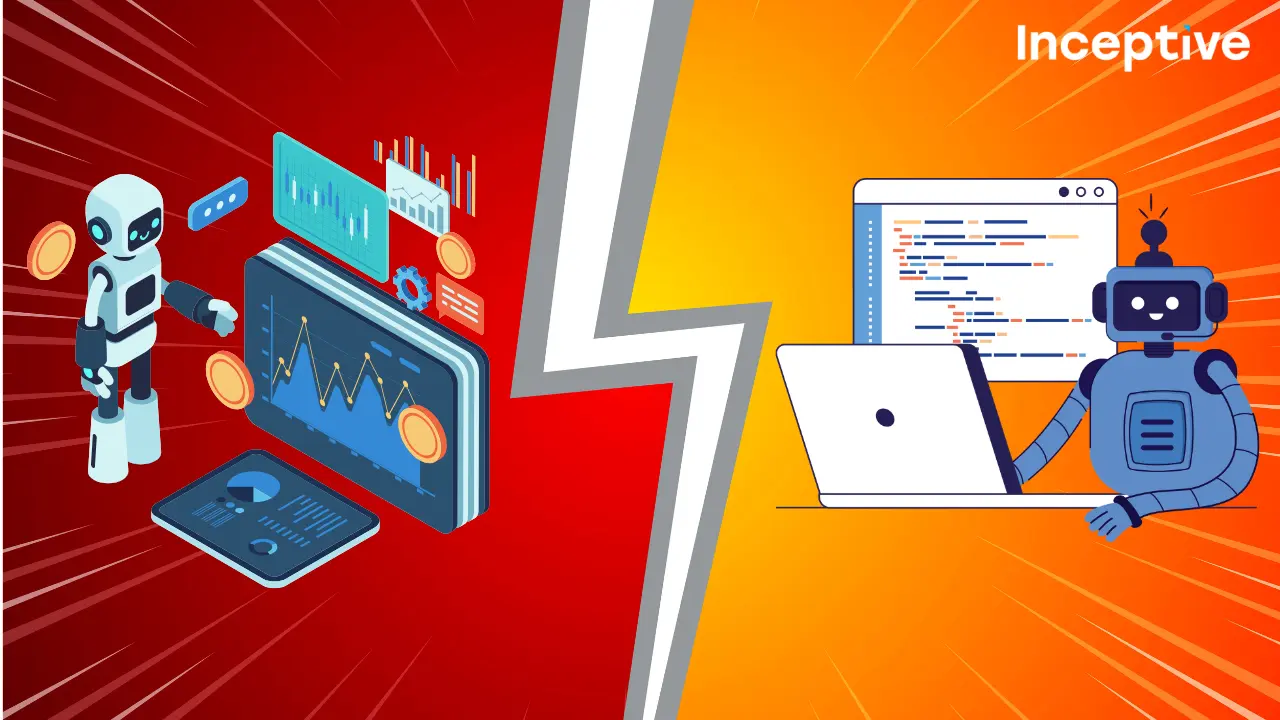
Understanding Generative AI: The Foundation of AI-Driven Creativity
Generative AI refers to artificial intelligence models designed to create new content, ideas, or outputs based on existing data patterns. These models are trained on massive datasets and use advanced machine learning algorithms to generate text, images, audio, code, or video.
Over the past few years, Generative AI technology has become widely adopted across industries due to its ability to automate creative and analytical tasks. Businesses are increasingly using generative models to streamline processes such as content creation, data analysis, customer engagement, and software development.
The core capability of Generative AI models lies in their ability to predict and generate outputs that resemble human-created content. For example, these systems can write articles, draft marketing campaigns, generate product descriptions, or even create complex code structures.
Some common applications of generative AI include:
-
AI-powered content writing and blog generation
-
Automated marketing copy and campaign ideation
-
Code generation and developer assistance
-
Image and video creation using AI models
-
Conversational AI systems and chatbots
-
Data summarization and knowledge extraction
Because of these capabilities, generative AI has become an essential component of digital transformation strategies across sectors such as technology, healthcare, finance, and retail.
However, despite its impressive capabilities, Generative AI primarily focuses on producing outputs rather than independently executing actions or making decisions. This is where Agentic AI systems introduce a new level of intelligence and autonomy.
What Is Agentic AI? The Rise of Autonomous AI Agents
Agentic AI represents the next stage in the evolution of artificial intelligence. Instead of simply generating information, Agentic AI systems are designed to pursue goals, make decisions, and perform actions autonomously.
An AI agent is essentially a system capable of observing its environment, analyzing available information, and taking steps to achieve a defined objective. Unlike traditional AI tools that respond to prompts or instructions, Agentic AI frameworks can plan multi-step tasks, adapt to changing conditions, and continuously improve outcomes.
In practical terms, Agentic AI behaves more like a digital assistant with decision-making capabilities rather than a tool that merely produces responses.
Key characteristics of Agentic AI include:
-
Goal-oriented task execution
-
Autonomous decision-making
-
Continuous learning and adaptation
-
Multi-step planning and reasoning
-
Integration with external tools and systems
For instance, an Agentic AI workflow might automatically monitor business data, analyze trends, generate insights, communicate findings, and execute operational tasks — all without requiring constant human prompts.
This ability to combine reasoning, planning, and execution makes Agentic AI a powerful technology for enterprise automation, intelligent operations, and AI-driven business transformation.
Key Differences Between Agentic AI and Generative AI
While both technologies belong to the broader AI ecosystem, their roles and capabilities differ significantly. Understanding these differences helps organizations choose the right approach when designing AI-powered business solutions.
1. Purpose and Functionality
The primary difference between Generative AI vs Agentic AI lies in their purpose.
Generative AI is designed to produce content or information, such as text, images, or code. It responds to prompts and generates outputs based on patterns learned during training.
Agentic AI, on the other hand, is built to take actions and accomplish goals. Instead of simply generating responses, these systems can analyze tasks, create execution plans, and perform operations autonomously.
In simple terms:
-
Generative AI creates content
-
Agentic AI completes tasks
2. Level of Autonomy
Another critical distinction involves autonomy and decision-making capabilities.
Generative AI requires human input to function. A user must provide instructions or prompts, and the system then generates a response.
Agentic AI operates with greater independence. Once given a goal, the AI agent can determine how to achieve that objective by selecting tools, executing workflows, and adjusting strategies.
This makes Agentic AI especially valuable in complex environments where continuous decision-making is required.
3. Workflow Execution
Generative AI typically performs single-step outputs, such as writing an article or summarizing information.
Agentic AI systems can handle multi-step workflows. They can break down complex tasks into smaller actions, complete them sequentially, and adapt the process when new information emerges.
For example, an AI agent used in digital marketing automation might:
-
Analyze audience data
-
Identify campaign opportunities
-
Generate content using generative AI
-
Schedule posts
-
Track performance metrics
-
Optimize the campaign automatically
This level of workflow automation is one of the defining advantages of Agentic AI technology.
Resource Center
These aren’t just blogs – they’re bite-sized strategies for navigating a fast-moving business world. So pour yourself a cup, settle in, and discover insights that could shape your next big move.
How Is Generative AI Changing Software Development?
The evolution of software development has always been shaped by innovation—from the rise of agile methodologies to the adoption of cloud-native architectures. Today, a new paradigm is rapidly redefining [...]
How Are Businesses Using Generative AI to Improve Productivity?
In today’s rapidly evolving digital economy, productivity is no longer driven solely by human effort or traditional automation. Businesses are increasingly leveraging generative AI for business productivity to unlock [...]
How Can Generative AI Improve Data Analysis and Insights?
In today’s data-driven economy, organizations are inundated with vast volumes of structured and unstructured data. While traditional analytics tools have played a critical role in extracting insights, they often [...]
